

There are many different types of powers that control how we perceive the world around us and alter our behavior, such as social and institutional influences. Our daily experiences are shaped by forces we can’t control mixed with ones that we can. How we choose to interpret and reflect upon our environment is all influenced by our experiences. These experiences and environments will always have some kind of power over us, even if we do not recognize it.
Socialization:
Socialization is a strong influence of power that has control over daily life. Socialization is a process done by multiple agents that adjusts throughout a lifetime that shapes how we perceive our experiences and teaches us our societal norms. Peer groups and family are some important agents of socialization that greatly impact perception.
Peer Groups:
Peer groups in school is also a sense of community , there is a sense of connection and this type of connection can satisfy a large area of social needs. This fulfillment and the way you interpret the interactions dependent on context can lead to higher motivation socially and academically. Another contribution to peer groups that impacts behavior is the self-fulfilling prophecy. The self-fulfilling prophecy is the idea that humans alter their behavior based on how the believe they are perceived. We become what people expect us to be. From an academic perspective studies have shown that the students who have a good reputation and relationship with the teacher are more likely to perform better. Peer groups can play a strong role in the self-fulfilling prophecy, because kids will act how their friend group expects them to act to get a sense of belonging.
Family:
Family has a lot of power by shaping morals and values and contributes a lot of key factors through parenting style. The way kids are raised will affect not only how they handle problems, but will shape their behavior and tell what kinds of issues they might internalize. Parenting style is very revealing around the time a kid starts going to school. How they act in school is greatly influenced and will cause them to either internalize or externalize their problems. Some behaviors of a kid who may not be experiencing a good parenting style is if they take out their anger on other students. If something frustrates them, they might take this energy and use it to fuel unconventional behaviors like tantrums. Acting out with rage is an example of externalizing these problems. Kids who internalize their problems might struggle with socializing and mental health.
Experiments:
There have been multiple experiments that play with the idea of power and authority. The two examples are the Stanford Prison Experiment and the Stanley Milgram Shock Experiment. Both of these experiments later on were considered to be a little unethical. They were performed before there were stricter guidelines for testing. Stanley Milgram was administered to see the effects of obedience to authority while the Stanford Prison Experiment was done to see how normal people react when they are put in a position of power.
Stanford Prison Experiment:
An important experiment that shows how too much power affects the psyche was the Stanford prison experiment. Before there were more strict guidelines on ethical experimentation, the Stanford prison experiment took place. This experiment was done to test what would happen when you take a sample of completely average people and put them into a position of power. The experiment split up a group randomly into two categories, prisoners and prison guards. The prison guards were really being tested to see how far they would go, what they would do to other people, would they fully accept the role, and seeing if the situation would get out of hand. Part of this experiment is to play with the idea that out of power unconventional means of deindividuation and dehumanization and seeing the impacts when it is institutionalized. The results of Zimbardo’s experiment were so gruesome that the experiment only ended up lasting six days and the experiment was supposed to take place for two weeks. The after affects of this experiment was psychologically destructive.
Stanley Milgram Shock experiment:
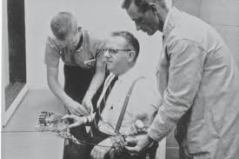
Another experiment that demonstrated the idea of power was the Stanley Milgram obedience to authority experiment. The experiment is set up so that everyone is in on what is actually happening except the person given the role of teacher. The teacher was under the impression that they were willingly hurting another person because they were instructed to do so. The fact that the teacher was kept out of the loop created a lot of controversy with this experiment in the sense that it was considered unethical. According to Stanley Milgram, it is set up in learner teacher style, where the learner is asked questions about things they are unfamiliar with and get them wrong. When the learner gets a question wrong it is instructed that the teacher shock the learner with growing intensity in voltage each time. What would cause someone to willingly hurt another person? The actual purpose of the experiment was to see obedience to authority on a smaller scale and try and find an explanation for the occurence of the holocaust. In the Nuremberg trials, there was a common response from Nazis when asked why they did what they did. The majority had said that they were simply following orders. This whole experiment was a play on obedience to authority.
Think about it:
Power can impacts people consistently whether they realize it or not. Escaping this kind of power seems to be nearly impossible and makes you question if there even if a free will. The way we are raised and the experiences we have will change us forever and shape our personality, that is out of our control. Being able to reflect on your own actions and making a conscious effort to dissect your personality and perceptions can help you break some of this control.































 Emily's Writing 121 Blog